

How Can Marketing Use the Surreal and Absurd to Create Memorable Content?
Here’s a question for you: when was the last time a marketing campaign made you do a double-take? Not just a “that’s nice” scroll-past, but a full-on “wait, wtf..?” moment that stopped you in your tracks and made you question reality for a second?
In a world drowning in sensible marketing, safe brand messaging and by-the-book campaigns, the surreal and absurd aren’t just nice-to-haves – they’re your secret weapon for cutting through the noise. And nowhere is this more evident than in the wonderfully bonkers Cat Cab campaign we did this summer for Cats Protection.
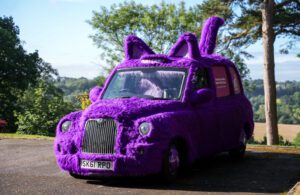
Enter the Cat Cab: A Feline Marketing Marvel
Picture this: you’re walking through central London, minding your own business, when a life-sized purple, furry cat taxi rolls past. Not a taxi with cat ears stuck on top. An actual, fur-covered, whisker-sporting, tail-swishing London cab that’s been completely transformed into a two-ton moggy. Complete with sound system and karaoke equipment.
Your brain short-circuits. Is this real? Am I dreaming? What was in my morning coffee today?
That’s exactly the point.
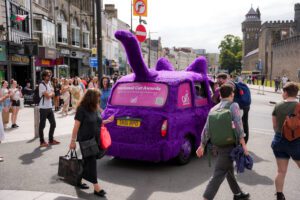
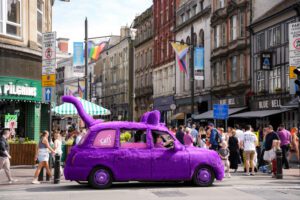
When Cats Protection came to Hussel Marketing with a brief to raise awareness for the National Cat Awards, we didn’t settle for posters or social media ads. We asked a beautifully absurd question: “What if a car could purr?” From that seed of surrealism, the Cat Cab was born: a campaign that toured five major UK cities – London, Cardiff, Birmingham, Manchester, and Glasgow – that turned streets into impromptu parties and made thousands of people genuinely lose their minds over a feline-themed vehicle.
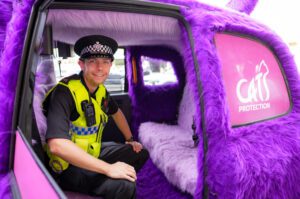
The execution was delightfully extra: fur-covered everything, branded QR codes for live public voting, a full karaoke setup (naturally dubbed “Cataoke”), and a promotional team armed with cat facts and infectious enthusiasm. The whole thing was bonkers. It was brilliantly inexplicable. It was utterly unforgettable.
Why Surreal Marketing Works
There’s solid psychology behind the madness. Our brains are pattern-recognition machines, constantly filtering out the familiar to focus on the novel. When something breaks the pattern – really breaks it – we pay attention. We stop, we stare, we engage.
Surreal marketing creates what psychologists call a “cognitive interruption.” Your brain expects a normal taxi. It encounters a giant cat instead. That mismatch demands resolution, forcing deeper processing and creating stronger memory encoding. Translation? People remember the weird stuff.
And we should know: we specialise in weird stuff…
But it’s not just about being random for randomness’s sake. The Cat Cab worked because the absurdity was purposeful. It celebrated the wonderfully quirky nature of cats themselves: animals that have owned the internet precisely because they’re delightfully unpredictable. And cute. The campaign’s surrealism matched the brand’s essence perfectly.
Moreover, surreal marketing is inherently shareable. Nobody photographs a normal taxi. Everyone photographs a purple cat taxi. The Cat Cab generated hundreds of user-generated content moments, with people stopping traffic (literally) to capture and share their encounters. Influencers jumped in for karaoke sessions. TikTokers chased the cab down streets. Dog people even grudgingly admitted it was pretty cool.

The Emotional Connection
Here’s where surreal marketing really shines: it makes people feel something. Not just “oh, that’s nice” but genuine joy, surprise, delight. The Cat Cab wasn’t selling; it was gifting people a moment of unexpected wonder in their ordinary day.
That emotional response creates powerful brand associations. Cats Protection became the charity that made people smile, laugh and share that joy with others in the moment. The campaign reminded people that rescue cats exist not just as a worthy cause, but as sources of genuine happiness that the National Cat Awards celebrate.
The results speak for themselves: record-breaking awareness for the Awards, thousands of real-world engagements, massive social reach. More importantly, the campaign reinforced what Cats Protection does – saves moggies – in a way that generated both emotion and action.
The Wider Impact of Absurdist Campaigns
The Cat Cab represents a broader shift in effective marketing. As consumers become increasingly savvy and ad-resistant, brands need strategies that don’t feel like advertising at all. Experiential campaigns that embrace the surreal create experiences worth having for their own sake. The marketing becomes the entertainment.
This approach also builds brand personality. Safe, sensible campaigns blend together. Weird, wonderful ones stand out. The Cat Cab positioned Cats Protection as creative, confident, and just the right amount of cheeky – exactly the kind of organisation people want to support.
Furthermore, surreal campaigns generate earned media that paid advertising simply can’t buy. News outlets cover them. Social platforms amplify them. People talk about them long after the activation ends. The Cat Cab’s impact extended far beyond its week-long tour, living on through content, conversations and collective memory.
The Balance: Surreal with Strategy
The key to successful surreal marketing is ensuring the absurdity serves the brand. The Cat Cab worked because it was weird with purpose: every element, from the fur to the on-brand purpleness, supported the campaign’s goals while celebrating the wonderfully quirky nature of cats.
Random weirdness confuses. Strategic weirdness converts.

The Takeaway
In a marketing landscape cluttered with safe, sensible, forgettable campaigns, the surreal and absurd offer something precious: genuine cut-through. They create the moments people remember, share and talk about to anyone who’ll listen. They transform marketing from interruption to entertainment.
So how can you use the surreal to create memorable content? Simple: dare to be different. Ask ridiculous questions. Build giant purple cat taxis. Embrace the beautifully bonkers.
Because sometimes, the most effective marketing strategy is the one that makes people wonder if they’ve had too much coffee.
Spoiler: they haven’t. Your campaign is just that good.