

Can Street Activations Be the Basis for a Successful Multi-Year Marketing Campaign?
Many brands treat experiential marketing like a one-night stand. Quick hit. Make some noise. Move on. Next quarter, completely different campaign. No connection. No momentum. Just isolated moments that fade as quickly as they appeared.
But what if street activations weren’t tactical executions?
What if they were the foundation for sustained, multi-year campaigns that continuously reinforce your brand positioning and create distinctive identity in your sector?
Not only can street activations be the basis for successful long-term campaigns: they might be the most powerful way to build sustained brand differentiation.
The Problem with Campaign Amnesia
Walk into any marketing department and you’ll see the same pattern: brilliant activation in Q1, completely different approach in Q2, another pivot in Q3. By Q4, nobody remembers what you stood for in January.
This isn’t strategic flexibility. It’s brand schizophrenia.
Every time you start from scratch, you’re throwing away accumulated equity. You’re asking audiences to relearn who you are. It’s exhausting and devastatingly expensive.
The brands that dominate their categories don’t campaign-hop. They identify a distinctive approach and hammer it relentlessly. Coca-Cola’s happiness. Nike’s athletic inspiration. Red Bull’s extreme sports ownership. Multi-decade commitments to singular brand ideas.
So why don’t more brands apply this thinking to experiential marketing?
What Multi-Year Experiential Actually Looks Like
We’ve worked with Revolución de Cuba on multiple campaigns spanning several years now. Sustained experiential marketing isn’t about repeating the same activation endlessly. It’s about building a recognizable signature that becomes synonymous with your brand.
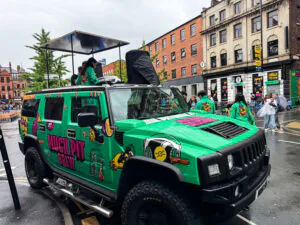
For Revs de Cuba, that experiential signature is “flipping the familiar into a fiesta.” Whether transforming a VW camper into a mobile Cuban party (Las Parrandas), delivering cocktails via drone, or creating drink-dispensing confession booths, the throughline is consistent: unexpected joy, Cuban culture brought to British streets.
Each activation builds on the last. Audiences anticipate “what will Revs de Cuba do next?” Press coverage compounds. Social content reinforces consistent brand personality. Over time, you don’t just create awareness: you create distinctiveness.
That’s strategic repetition with tactical variation.
The Compounding Effect
The benefits of experiential marketing compounds differently from those of, say, standard digital advertising. With paid ads, you’re renting attention. Stop spending, stop appearing. Every campaign starts from zero.
But experiential creates stories that live beyond the activation. PR coverage. User-generated content. Brand folklore. The second and third activations benefit from the first. By the tenth, you’re not explaining what kind of brand you are – because people already know.
Our work with Revolution Bars demonstrates this beautifully. The Free Burger Booth was part of an ongoing relationship where each campaign builds brand equity. By launch, their audience was primed to expect creative experiences. The activation didn’t establish credibility. It delivered on expectations and pushed boundaries further.
The Cost Efficiency Nobody Talks About
Sustained experiential campaigns are often more cost-efficient than one-offs. Consider the investment in isolated campaigns: concept from scratch, building from zero, educating audiences, no accumulated equity, starting social conversation from silence.
Sustained campaigns? Core concept established, variations on proven themes, accumulated recognition, press anticipating your moves, audiences primed to engage. The tenth activation costs a fraction of the time and money of what ten isolated campaigns would have cost. Whilst delivering exponentially more impact.
When It Works vs When It Doesn’t
Not every brand should pursue multi-year experiential campaigns. It requires specific conditions: commitment from leadership, distinctive approach that’s ownable and different, consistency in brand strategy, patience for long-term results to compound, and creative discipline knowing when to evolve vs repeat.
The brands that succeed have clear identities, committed leadership, and confidence to own a distinctive approach for the long term.
The Confidence Factor
Most brands don’t pursue sustained experiential campaigns not because they don’t work, but because CMOs fear being seen as repetitive. There’s pressure to constantly show boards something “new.” So every quarter brings fresh campaigns, new directions, different agencies.
The result? Lots of activity. Zero memorability.
But the most successful brands know distinctive building requires repetition. Apple’s product launches follow a formula. John Lewis Christmas ads are predictably emotional. Nike consistently champions athletes.
Repetition isn’t creative bankruptcy. It’s strategic discipline. And in experiential marketing, strategic repetition is the only thing that actually works at scale.

Building Your Own Signature
If you’re considering sustained experiential campaigns, start by identifying your brand’s experiential signature. In other words, the distinctive way you show up that only you can own.
Your signature should stem from authentic brand DNA, be distinctive enough to own, flexible enough to adapt across contexts, interesting enough to sustain audience interest, and consistent enough to build recognition.
Once identified, the question isn’t “what completely different campaign should we do next?” It’s “how do we evolve our signature for this moment while staying recognisably us?”
The Social and PR Multiplier
Multi-year campaigns create something magical: anticipated content. When audiences know your brand does interesting things in the real world, they start watching for it. Following your channels. Tagging friends with “remember when they did that thing?”
This transformed relationship – from interruption to anticipation – is marketing’s holy grail.
Meanwhile, journalists get bored of one-off stunts. But brands with a track record of interesting experiential work? Journalists start anticipating your moves, sometimes reaching out asking “what have you got coming up?” That accumulated credibility can’t be bought.
The Bottom Line
Can street activations be the basis for successful multi-year campaigns?
In a world of fleeting attention and endless noise, sustained experiential marketing builds cumulative advantage. Each activation strengthens the next. Over time, you don’t just create awareness. You create ownership of distinctive brand territory.
But it requires courage. The courage to commit. The courage to repeat. The courage to resist constant pointless reinvention.
The question isn’t whether it works. It’s whether you’re brave enough to do it.
But don’t worry, Hussel is an expert at helping you find that courage and we’re on hand to support you through the whole campaign process.
Because the brands that are winning aren’t the ones with flashiest quarterly stunts. They’re the ones with discipline to find a distinctive approach and confidence to stick with it.
That’s not just marketing. That’s brand building.
And it starts with a street activation so authentically you, you can imagine doing variations of it for years without getting bored.
Find that. Then do it relentlessly.